
AI Proposal Writing Software for Federal RFPs: Top 3 Bid Writing Tools for Government Contractors in 2026

Ready to elevate your Federal Bid Writing game in 2026? Schedule a discovery call with #1 Proposal Writing Software for Government Bids.
AI proposal software focuses on narrative authoring, bid writing, and proposal drafting, helping teams create structured, persuasive responses. AI RFP software, by contrast, supports end-to-end response automation, including requirement extraction, compliance matrices, content governance, and submission workflows. For a full evaluation of AI RFP software platforms, see our Best AI RFP Software for Enterprises (2026) guide.
What Makes Federal RFPs Different from Commercial RFPs?
Federal RFPs in government contracting are fundamentally more complex than commercial Requests for Proposal because they operate under strict federal regulations such as the Federal Acquisition Regulation (FAR) and agency-specific compliance standards.
A single government contract proposal often includes 40-100+ solicitation documents of all format types - covering Addendums, Statements of Work, evaluation criteria, compliance matrices, security questionnaires, pricing tables, and scoring Guide. (Source: APMP & GovWin).
According to the U.S. Government Accountability Office, over 35% of federal bid protests are tied to evaluation or compliance errors, not technical capability - making proposal management and accuracy critical.
Federal proposal teams must also document past performance summaries, past projects, and audit-ready narratives, all while maintaining version control and traceability across large, multi-user collaboration workflows.
Unlike commercial proposal creation, federal proposal development demands airtight compliance checks, stringent submission checklists, risk flagging, and contract review, often across dozens of SMEs and reviewers. This complexity is why modern AI proposal software, Agentic AI workflows, and AI-powered proposal management platforms are rapidly becoming essential for federal RFP responses, replacing manual processes that simply don’t scale.
Federal procurement follows detailed rules like the Federal Acquisition Regulation (FAR). Agencies update FAR several times a year to change rules, thresholds, and compliance standards. Government contractors often get amendment notices that change requirements, evaluation criteria, or deadlines after the initial release. FAR updates and subsequent RFP amendments can introduce new sections to solicitation documents, forcing proposal teams to rework responses, adjust compliance matrices, and realign win themes mid-cycle - a leading cause of errors and win leaks without a disciplined change-tracking process.
The Government Accountability Office (GAO) routinely resolves more than 1,000 bid protests annually, and protests achieve some form of relief in roughly half of cases, underscoring how evaluation and compliance disagreements significantly shape award outcomes in federal procurements (Source: GAO)
Government RFPs vs Commercial RFPs - Key Differences
Dimension | Government RFPs (Federal /State/ County) | Commercial RFPs |
|---|---|---|
Compliance Requirements | Extremely strict; governed by FAR, agency clauses, and mandatory compliance matrices | Flexible; compliance exists, but it’s lighter and less rigid than government RFPs |
Clarifications & Q&A | Limited and formal; questions must follow strict timelines and written processes, published public | Easy to reach POCs; setting up calls and clarifications are common |
Evaluation Process | Rule-based, score-driven, and fully auditable against evaluation criteria | Relationship-driven sometimes; evaluators may weigh context and intent |
Proposal Structure | Prescriptive formats, page limits, font rules, and section ordering, extensive submission checklist. | Flexible structure; creativity and storytelling are encouraged |
Risk of Rejection | High - non-compliance can lead to immediate disqualification | Lower - minor gaps can often be clarified post-submission |
The Real Challenges in Federal Proposal Management Today
Federal proposal management is under increasing pressure as RFP volume continues to rise, timelines shrink, and proposal teams are expected to deliver near-perfect compliance on every submission.
A single proposal manager often juggles dozens of document-centric workflows - from solicitation documents and amendments to pricing tables, past performance, and security questionnaires, each with hard deadlines and little margin for error.
Most federal proposal workflows are still highly manual, relying on Word documents, spreadsheets, email threads, and disconnected content repositories. This slows proposal development, creates version-control issues, and forces teams to spend more time coordinating than writing. As response timelines tighten, even minor delays - waiting on SMEs, reconciling edits, or reworking sections after amendments - can derail an otherwise winnable bid.
The result is proposal fatigue across teams, inconsistent quality across sections, and avoidable last-minute scrambles that directly impact win rates in high-stakes government contracting.
Why Legacy Proposal Management Software Falls Short for Government RFPs
Traditional proposal management software was built for simple commercial proposals, not for the rigor of government contracting. Federal RFPs demand far more than machine learning, templates and keyword rules, yet most legacy GovCon proposal tools stop there.
Where legacy tools break down:
- Static, rule-based compliance matrices: Most tools rely on keyword matching to build compliance matrices, missing nuanced requirements across FAR clauses, amendments, and agency supplements, leading to avoidable non-compliance.
- Poor interpretation of solicitation language: Federal Requests for Proposal require cross-referencing multiple documents (SOWs, Q&As, amendments). Non-AI tools struggle with legal nuance, evaluation criteria, and mandatory instructions.
- Weak traceability & audit readiness: Government proposals require section-level traceability and audit trails. Legacy tools lack native linkage between RFP requirements, proposal responses, and revisions.
- Manual content reuse: Proposal teams must manually adapt past performance summaries, win themes, and security questionnaires, slowing proposal development and increasing error risk.
- Fragmented collaboration: Limited collaboration tools in everyday tools like MS Teams, Slack and Outlook, force SMEs into email and Word docs, making it hard to backtrack versions, delaying reviews and breaking response workflows.
- No intelligence layer: Without Agentic AI, workflow automation, or NLP-driven document intelligence, these tools cannot produce a first winnable proposal draft or adapt to frequent RFP changes.
In short, legacy proposal writing software manages files, not federal complexity. Modern government proposals require AI-native, agentic platforms purpose-built for compliance-heavy, high-stakes bids.
What Is Agentic AI Proposal Writing Software for Federal RFPs?
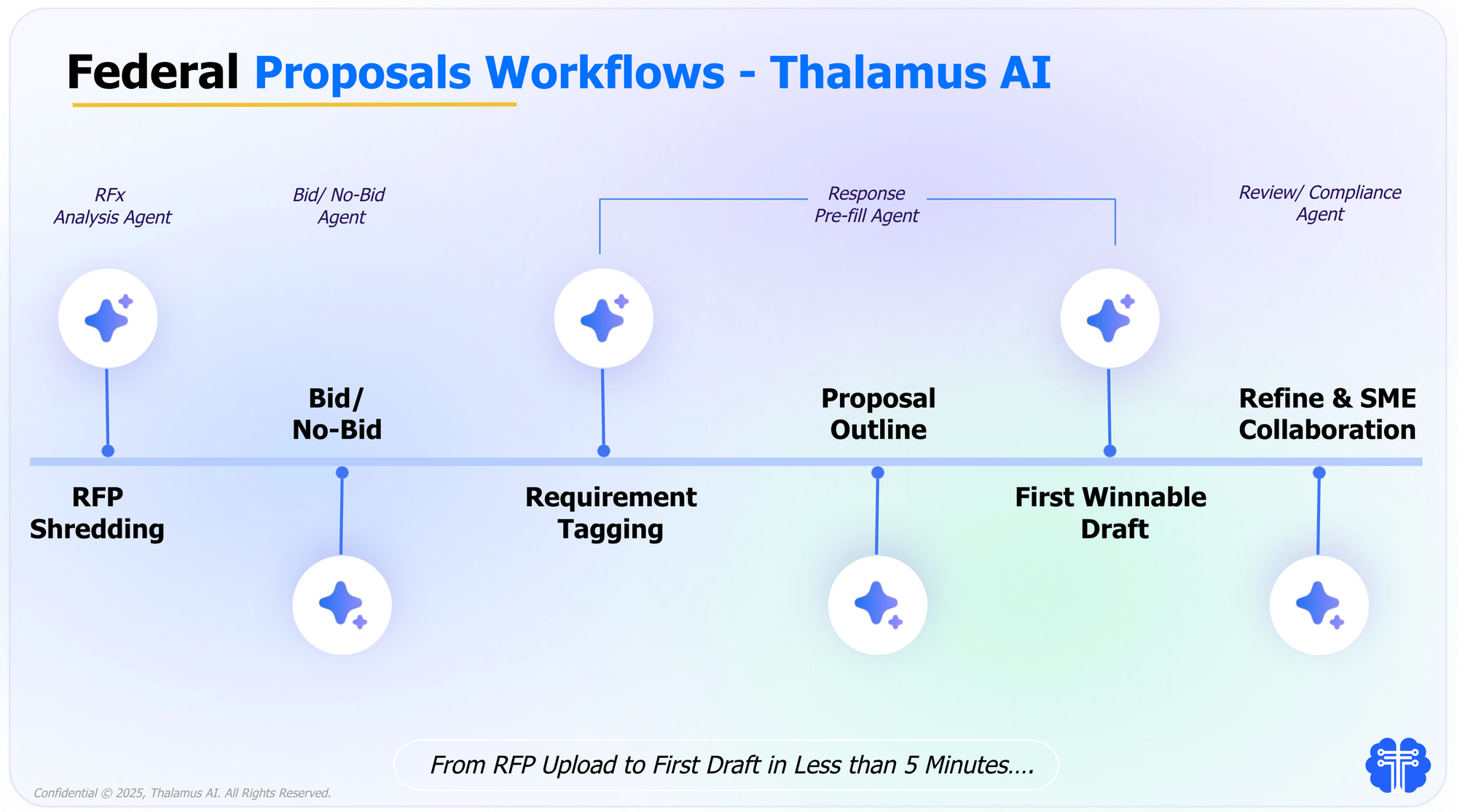
Agentic AI proposal writing software is advanced category of AI-powered proposal management software designed specifically for the complexity of Federal RFPs and government contracts. Unlike traditional proposal tools or single-bot generative AI systems, agentic platforms use multiple specialized AI assistants - each aligned to a critical step in the proposal management workflow - to orchestrate the entire federal proposal lifecycle.
How Agentic AI Works (At a Technical Level)
At its core, Agentic AI combines Generative AI, Retrieval-Augmented Generation, Natural Language Processing (NLP), machine learning, and workflow automation into an orchestrated system of AI agents. Each agent has a defined responsibility and shared context, enabling the platform to behave like a real proposal team rather than a standalone AI tool.
Agentic systems do not use fixed templates or keyword rules. They understand the context of RFPs, solicitation documents, Statements of Work, evaluation criteria, and compliance standards. They treat these as connected inputs. This helps produce structured and compliant proposal outputs.
Key AI Agents in an Agentic Proposal Platform
- RFP Shredding & Analysis Agent
This AI assistant ingests Federal RFPs, RFIs, RFQs, and amendments, then breaks them into structured compliance matrix, proposal sections, bid checklists, and compliance requirements. It reads beyond keywords - understanding intent, dependencies, and hidden compliance risks common in government contracting. - Bid / No-Bid Decision Agent
Using past performance data, product offering fit, opportunity scoring, evaluation criteria, and win-loss history, this agent supports bid/no-bid decisions early in the response process, helping proposal managers focus on high-probability government contract proposals. As federal procurement process has become more structured and compliance-driven, with proposals often rejected at initial screening stages, evaluating opportunity strength upfront is critical before committing bid resources. - Compliance & Requirement Tagging Agent
Federal RFPs demand strict adherence to FAR clauses, agency supplements, and security questionnaires. This agent automatically builds a compliance matrix, flags gaps, and maintains traceability between proposal responses and original RFP requirements - critical for audits and evaluations. - Response Pre-Fill & Drafting Agent
Powered by an AI-based content library, this agent pulls from trusted sources such as Google Drive, SharePoint, internal knowledge hubs, and past proposal drafts to generate AI-powered proposal drafts. The result is a First Winnable Proposal Draft - not a generic narrative. - Win Theme & Past Performance Agent
This agent maps relevant past performance summaries, win themes, and technical differentiators to each proposal section - ensuring alignment with evaluation criteria and strengthening competitiveness in high-stakes government bids. - Review, Risk & Compliance Agent
Before submission, this agent performs automated compliance checks, tone consistency reviews, and risk flagging - covering pricing tables, IP clauses, data rights, and contract risk analysis.
What This Means in Practice for Federal Proposal Teams
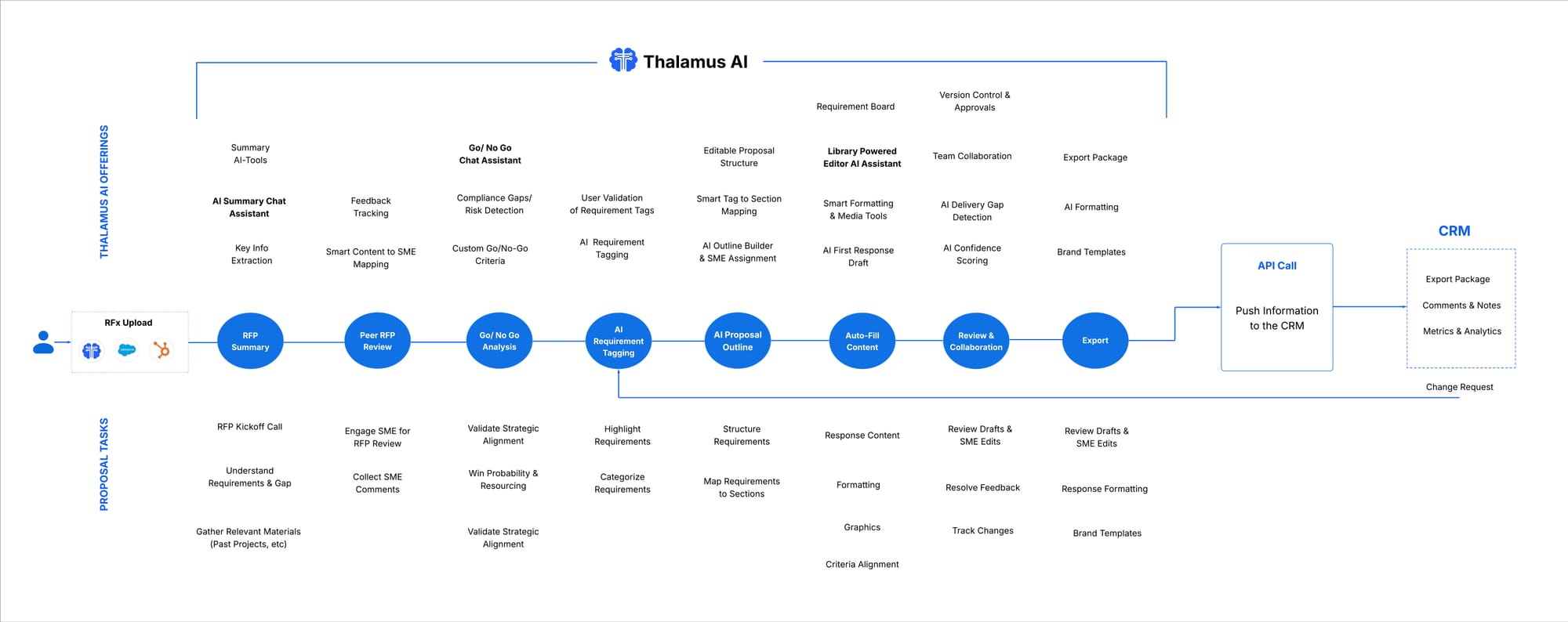
With an agentic AI platform, proposal teams no longer start from blank Word documents or manually stitch together content from disconnected systems. Instead, the platform coordinates proposal creation, collaboration tools, multi-user workflows, and compliance checks in one unified environment.
Agentic systems keep logs of agent activities and audit trails. They support enterprise-level security like SOC 2, GCC High, and Azure Cloud. They also allow proposals in multiple languages. These features are important for modern government buying.
Platforms like Thalamus AI apply this agent-based architecture end-to-end, allowing proposal managers, bid writers and subject-matter experts to collaborate through AI, not around it. The outcome is faster response timelines, higher compliance accuracy, and improved win rates across Federal RFP responses.
In short, Agentic AI proposal writing software transforms federal proposal development from a manual, document-centric process into an intelligent, automated, and fully orchestrated system - built for the realities of government contracting.
Key Features to Look for in Government Bid Writing Software
Modern government bid writing software must go far beyond document storage or basic AI text generation. Federal RFPs demand precision, traceability, and speed at scale. The most effective platforms are Agentic AI–driven, embedding intelligence across the entire proposal lifecycle, from RFP intake to final submission. Below are the non-negotiable capabilities to look for when evaluating AI-powered proposal tools for government contracting.
1. AI-Based, Vectorized Content Libraries Built for Federal Proposals
Federal proposal teams manage thousands of offering documents, past performance narratives, compliance responses, and proposal templates across SharePoint, Google Drive, and internal Content Management Systems. Traditional libraries rely on manual tagging and keyword search - leading to outdated or conflicting content.
An AI-based content library should:
- Store content in vectorized, AI-native formats (not folders)
- Retrieve the most relevant, compliant response by context - not keywords
- Track version history, usage, and approval status and Ownership of Content.
- Pull trusted content directly from Google Drive, SharePoint, and internal knowledge hubs via Real Time API Integration.
This ensures proposal teams reuse accurate, approved content - without risking compliance or factual drift.
2. RFP Shredding, Compliance Mapping & Requirement Tagging at Scale
Federal RFP documents often include hundreds of pages across solicitation documents, Statements of Work, amendments, and security questionnaires. Manually creating a compliance matrix is slow and error-prone.
Advanced government RFP software should use AI agents to:
- Automatically shred RFP documents line by line
- Identify instructions, evaluation criteria, compliance clauses, and pass/fail requirements
- Generate structured compliance matrices and bid checklists
- Flag mandatory vs optional requirements across volumes
This eliminates missed clauses and ensures full compliance coverage before drafting begins.
3. First Winnable Proposal Draft (Not Just AI Text)
Generic AI proposal writers generate paragraphs. Agentic AI systems generate proposal drafts aligned to federal evaluation criteria.
Look for platforms that can:
- Auto-assemble proposal sections based on RFP structure
- Apply proposal templates and layout rules by volume
- Draft responses using SME approved content, win themes, and past performance
- Maintain traceability between draft content and RFP requirements
The outcome should be a First Winnable Proposal Draft - ready for Color Team reviews, not a rough AI output that needs rewriting.
4. Data-Driven Bid/No-Bid Decisions (Before Resources Are Burned)
With increasing RFP volume and early-stage rejections, Bid/No-Bid decisions can no longer rely on gut feel.
Best-in-class government bid software supports:
- Opportunity scoring based on past performance & Offering fit
- Evaluation criteria weighting
- Win-loss history and competitor signals
- Contract risk analysis and resource alignment
This enables leadership and capture teams to focus only on high-probability government contract proposals.
5. Agentic AI Workflows Across the Full Bid Lifecycle
True AI proposal software is not a single assistant - it’s a coordinated system of AI agents.
Agentic AI platforms orchestrate:
- RFP intake and shredding
- Compliance agents for checks and validation
- Drafting agents for proposal response generation
- Review agents for consistency and formatting
- Analytics agents for performance tracking
Each AI agent operates with a defined role, while workflow automation ensures continuous handoffs across the proposal lifecycle - from RFP upload to final submission.
6. Unified Platform for All Federal RFx Document Formats
Federal solicitations rarely arrive in a single format. A single opportunity may include PDF RFPs, Excel-based RFQs, Word RFIs, fill-in source selection templates, pricing spreadsheets, and portal-upload forms - each with different response expectations.
A modern AI proposal writing platform for federal RFPs must natively support all RFx formats within one system, without forcing proposal teams to switch tools or workflows.
An enterprise-grade platform should:
- Ingest PDFs, Word documents, Excel RFQs, structured forms, and portal-ready templates
- Automatically detect the RFx type (RFP, RFQ, RFI, security questionnaire, pricing sheet)
- Prompt User to Apply format-aware workflows for each document type - narrative drafting, table-based responses, pricing inputs, or compliance matrices
- Maintain traceability across mixed formats within the same bid lifecycle
- Enable consistent collaboration, compliance checks, and audit trails across every file type
This ensures proposal teams handle complex, multi-format federal opportunities in one unified workflow - reducing errors, eliminating manual rework, and accelerating response timelines.
7. Auditability, Security, and Enterprise Readiness
Government contracting requires:
- ISO-27001, SOC 2–aligned security, GCC High Security Compliance, FedRAMP Marketplace Listing
- Role-based access control
- Full audit trails for edits and approvals
- Secure cloud infrastructure (e.g., Microsoft Azure)
Agentic AI systems must log agent activity, content sources, and compliance decisions, ensuring transparency during audits, protests, or contract reviews.
Why Agentic AI Boost Federal Proposal Success
Federal proposal success depends on speed, compliance, and accuracy at scale. Platforms that combine AI agents, workflow automation, and intelligent content reuse consistently outperform legacy proposal management software - especially in high-stakes government contracts (Source: Thalamus AI, 2026)
In short, The future of government bid writing belongs to Agentic AI platforms built for federal complexity - not generic proposal tools with AI bolted on.
Top 3 Bid Writing Tools for Government Contractors in 2026
Thalamus AI vs GovDash vs AutoGen AI
Government RFPs are fundamentally different from commercial proposals. A single federal opportunity may include PDF solicitations, Excel-based RFQs, fill-in pricing templates, Word RFIs, security questionnaires, and portal-specific submission formats - all governed by strict compliance and audit requirements.
Most bid writing tools were not architected for this level of document diversity, compliance depth, and workflow orchestration. Below is how the leading tools in 2026 compare when evaluated through a federal proposal management lens.
1. Thalamus AI - Agentic AI Platform Built for Federal RFP Complexity
Best for:
Large and mid-sized government contractors handling complex multi-format federal RFPs, RFQs, security questionnaires, and compliance-heavy bids. Teams like Cardinal Correctional Care use Thalamus AI to move 5X faster on bids and double their win rates, without adding headcount. (Source: Thalamus AI, 2026)
Thalamus AI is an agentic AI proposal writing platform designed specifically to cater the complexity of federal bid writing process. Instead of relying on a single AI workflow, Thalamus orchestrates multiple specialized AI agents across the entire bid lifecycle. Used by clients such as Cardinal Correctional Care, Thalamus help their teams work bids 5X faster and win 2X more (Source: Thalamus AI, 2026)
Where Thalamus AI stands out for GovCon teams:
- Multi-format RFx support: Handles PDF RFPs, Excel RFQs, Word RFIs, pricing templates, and fill-in source documents - within one unified platform
- Format-aware workflows: Different AI agents manage narrative sections, Q&A responses, pricing tables, and compliance matrices independently
- Vectorized content libraries: Past performance, win themes, and Proposal Content Documents are stored in AI-native formats for accurate retrieval - not flat keyword search
- Source-document writeback: Auto-fills answers directly into government-issued templates and spreadsheets
- Agentic orchestration: Dedicated agents for RFP shredding, compliance mapping, bid/no-bid analysis, drafting, review, and final checks
- Audit-ready design: Full traceability, activity logs, version control, and compliance validation aligned with federal standards
- Compliant with Federal Security Standards - ISO 27001, SOC2, GCC High, FedRAMP
Why it matters:
Federal proposal teams don’t work in a single document type or linear flow. Thalamus mirrors how real GovCon teams operate across formats, roles, and deadlines, while maintaining compliance and speed.
2. GovDash - Structured GovCon Tool with Limited AI Depth
Best for:
Small GovCon teams responding primarily to Narrative PDF-based federal solicitations
GovDash is designed specifically for government contracting and offers a more structured experience than generic proposal tools. It performs well for basic RFP organization and response tracking, especially when solicitations are narrative-heavy PDFs.
Common limitations GovCon teams encounter:
- Single-format workflow focus: Optimized mainly for PDF solicitations, limited support for Excel RFQs or fill-in pricing templates
- Limited AI orchestration: Uses AI for assistance, but not Agentic AI workflow automation
- Non-vectorized content storage: Libraries rely heavily on manual organization and keyword search
- Minimal source document writeback: Responses often require manual copy-paste into government templates
- Rigid workflows: Less flexibility when handling mixed-format opportunities within the same bid
Bottom line:
GovDash helps organize federal proposals, but teams handling complex, multi-format opportunities may find it difficult to scale without added manual effort.
3. AutoGen AI - Strong Generative Writing, Limited Federal Workflow Fit
Best for:
Narrative-heavy proposal drafting where content generation is the primary need
AutoGen AI focuses on generative AI for proposal writing, offering strong drafting and rewriting capabilities. It performs well when the primary challenge is text creation, not workflow orchestration.
Where it falls short for federal bids:
- Not agentic: Lacks multi-agent role separation across compliance, pricing, and drafting
- PDF-centric workflows: Limited handling of Excel RFQs, pricing tables, or structured Q&A forms
- No native compliance mapping: Compliance matrices and requirement tagging are largely manual
- Library management challenges: Content is not deeply vectorized, making reuse and governance harder
- UX complexity: Requires training to manage long, compliance-driven federal responses
Bottom line:
AutoGen AI is a capable AI writing tool, but federal proposal teams often need workflow intelligence, not just content generation.
Executive Takeaway for Government Contractors
- If your bids involve complex, multiple document formats, strict compliance, pricing templates, and audit requirements → Thalamus AI
- If your work is mostly PDF-based and smaller in scope → GovDash
- If your primary need is AI-assisted narrative writing → AutoGen AI
In 2026, winning federal contracts isn’t about writing faster - it’s about orchestrating compliance, content, collaboration, and accuracy at scale. That’s where agentic platforms separate themselves from traditional AI tools.
Clear Differentiator Table: Government Bid Writing Software (2026)
Differentiator | Thalamus AI | GovDash | AutoGen AI |
|---|---|---|---|
Built for Federal RFP Complexity | ✅ | ⚠️ | ❌ |
Agentic AI (Multiple AI Agents) | ✅ | ❌ Single AI workflow | ❌ Single generative AI flow |
Multi-Format RFx Support (PDF, Excel, Word, Forms) | ✅ | ⚠️ | ⚠️ |
Auto-Fill Back into Source Documents | ✅ | ❌ | ❌ |
RFP Shredding & Requirement Tagging | ✅ | ⚠️ | ❌ |
Compliance Matrix & Traceability | ✅ | ⚠️ | ❌ |
Vectorized AI Content Library | ✅ | ❌ | ❌ |
Bid / No-Bid Decision Intelligence | ✅ | ⚠️ | ❌ |
First Winnable Proposal Draft | ✅ | ⚠️ | ⚠️ |
Enterprise-Grade Security & Auditability | ✅ | ⚠️ | ⚠️ |
Why Thalamus AI Is the Best AI Proposal Writing Software for Federal RFPs
Federal RFPs are not just longer versions of commercial proposals - they are compliance-driven, audit-heavy, and unforgiving. Thalamus AI is built specifically for this reality. It is an AI-native, Agentic AI proposal writing platform designed to manage the full proposal lifecycle - from RFP intake to final submission, without forcing teams into manual workarounds.
Cardinal Correctional Care Proposal Team use Thalamus AI to move 5X faster on bids and double their win rates, without adding headcount. (Source: Thalamus AI, 2026)
Built for Federal-Grade Complexity, Not Generic Proposals
Thalamus AI supports every federal RFx format. These include PDF solicitations, Excel Q&A sheets, Word templates, pricing forms, security questionnaires, and portal-ready documents. Each document type runs on a dedicated workflow, ensuring proposals are written in the source format, not copied and pasted after the fact.
True Agentic AI, Not Just Generative Text
Thalamus AI uses 20+ specialized AI Agents, each responsible for a critical step in the federal proposal process:
- RFP Shredding & Requirement Tagging Agents interpret solicitation documents, Statements of Work, and evaluation criteria line by line
- Compliance & Traceability Agents generate compliance matrices and maintain audit-ready mapping
- Bid / No-Bid Agents score opportunities using past performance, win-loss data, and contract risk signals
- Drafting & Review Agents generate proposal sections, enforce tone and structure, and flag gaps before submission
This Agentic AI workflow mirrors how real federal proposal teams operate - only faster, more consistent, and fully traceable.
AI-Based Content Library That Learns Over Time
Thalamus AI replaces static, keyword-based repositories with a vectorized AI content library. Past performance summaries, proposal templates, win themes, and SME owned Content are continuously indexed, ranked, and reused based on context, not manual tagging. The platform connects directly to Google Drive, Microsoft SharePoint, and internal knowledge systems, ensuring teams always use the most current, approved content.
First Winnable Proposal Draft - Without Starting from Scratch
Federal proposal teams rarely lose because they lack content - they lose because they lose time. Thalamus AI generates a First Winnable Proposal Draft by auto-assembling compliant sections, mapped requirements, and tailored narratives in hours instead of weeks. Proposal managers can focus on strategy, not formatting or coordination.
Designed for Security, Auditability, and Enterprise Trust
Thalamus AI is built on AWS Cloud with option to setup Virtual Private Cloud on Microsoft Azure Cloud, aligned with SOC 2 Type II standards, and designed for enterprise-level security. Every AI action is logged, traceable, and reviewable - supporting audits, debriefs, and internal governance. This level of transparency is critical for government contracting teams managing high-stakes bids.
The Bottom Line
Thalamus AI is not a chatbot, a bolt-on AI feature, or a PDF-only tool. It is a full Agentic AI proposal writing platform purpose-built for federal RFPs, handling compliance, complexity, collaboration, and speed at scale.
For government contractors competing in regulated, deadline-driven procurements, Thalamus AI turns proposal management from a manual, document-centric process into an intelligent, automated, and winnable system.
Conclusion: The Future of Federal Proposal Writing Is Agentic
Federal RFPs are becoming more complex, more regulated, and more competitive each year. Longer solicitation packages, tighter compliance standards, frequent amendments, and higher rejection rates leave little room for manual processes or legacy proposal tools. In this environment, winning government contracts is no longer about writing faster - it’s about orchestrating the entire proposal lifecycle with precision.
Agentic AI proposal writing software represents a fundamental shift in how government contractors respond to Federal RFPs. By embedding AI at every stage - RFP shredding, compliance mapping, bid/no-bid analysis, drafting, collaboration, and final validation - Agentic platforms eliminate the fragmentation and inefficiency that slow teams down and introduce risk.
Thalamus AI stands apart because it was built specifically for federal-grade complexity. It supports every RFx format, maintains audit-ready traceability, enforces compliance by design, and generates a First Winnable Proposal Draft without forcing teams to start from blank documents or outdated templates. More importantly, it allows proposal managers, capture teams, and subject-matter experts to collaborate through AI - not around it.
As government procurement continues to evolve, the contractors who win consistently will be those who adopt AI-native, agent-driven proposal platforms - not tools that simply add AI on top of old workflows.
If your organization is serious about improving compliance accuracy, shortening response timelines, and increasing win rates in high-stakes federal bids, Agentic AI is no longer optional - it is the competitive advantage.
Thalamus AI is built for that future.
Ready to elevate your Federal Bid Writing game? Schedule a discovery call with #1 Proposal Writing Software for Government Bids.
- Read our Top 3 AI Proposal Software in 2026 comparison to see which platform leads in automation, multilingual proposals, and win-rate performance.
- Check out our full guide on How AI is Revolutionizing Proposal Management for an in-depth breakdown.
- Learn more about AI Agents in RFP Automation: AI Agents for RFP Automation: What They Are & Why Enterprises Are Finally Paying Attention
- Want to know what’s next in proposal management? Read the 12 RFP Trends Shaping Proposal Management in 2026.
- Want in-depth comparison? Read our in-depth RFP software comparison.
- For a deep dive into Agentic AI for Proposal/ Response Management, check out our post: How Agentic AI Platforms are Shaping the future of Proposal Management
- Additional Read: To Bid or Not to Bid? A Strategic Guide to Confident RFP Go/ No-Go Decisions
- Not sure which AI prompts actually win proposals? Read our guide: 7 RFP ChatGPT Prompts That Win More Bids (Faster).