
Everything you need to know about AI RFP Software
Imagine you run a bakery and need a large batch of cookies for a big event.
You could just pick the first supplier you find for ingredients. But what if another supplier offers better quality flour? Or can someone else deliver faster? Or another supplier gives you a better price?
So instead of choosing randomly, you send the same request to several suppliers.
You tell them exactly what you need:
- the type of ingredients
- the quantity
- the quality you expect
- when you need everything delivered
Then each supplier replies with their proposal explaining how they would fulfill your request and how much it would cost.
You compare the responses, look at the prices, timelines, and quality, and then choose the supplier that fits your needs best.
This simple process is exactly how RFPs work in business.
An RFP, or Request for Proposal, is when an organization asks multiple vendors to explain how they would solve a problem or deliver a service, so the organization can choose the best partner for the job.
In this blog, you will learn:
- What an RFP (Request for Proposal) is and how the RFP process works inside organizations
- The most common challenges proposal teams face when responding to complex RFP documents
- Why coordinating with subject matter experts and managing multiple documents slows down proposal workflows
- How AI RFP software helps automate requirement extraction, content reuse, and proposal drafting
- How to determine whether your organization actually needs AI RFP software and when it makes sense to adopt it
What is a RFP?
A Request for Proposal (RFP) is a structured procurement process organizations use to evaluate vendors and select the best partner for a project, product, or service.
In enterprise environments, an RFP is rarely a single document. Instead, buyers typically issue a contract package that may include multiple files such as:
- Technical requirement documents
- Security questionnaires
- Pricing templates
- Compliance forms
- Narrative response templates
Together, these documents define the evaluation criteria vendors must meet in order to be shortlisted or awarded the contract.
For vendors, responding to an RFP means preparing detailed proposal responses that demonstrate how their solution meets these technical, security, and operational requirements
Within most organizations, this responsibility falls on proposal teams and proposal managers, who coordinate the entire proposal development process, from analyzing the Request for Proposal to preparing final proposal drafts.
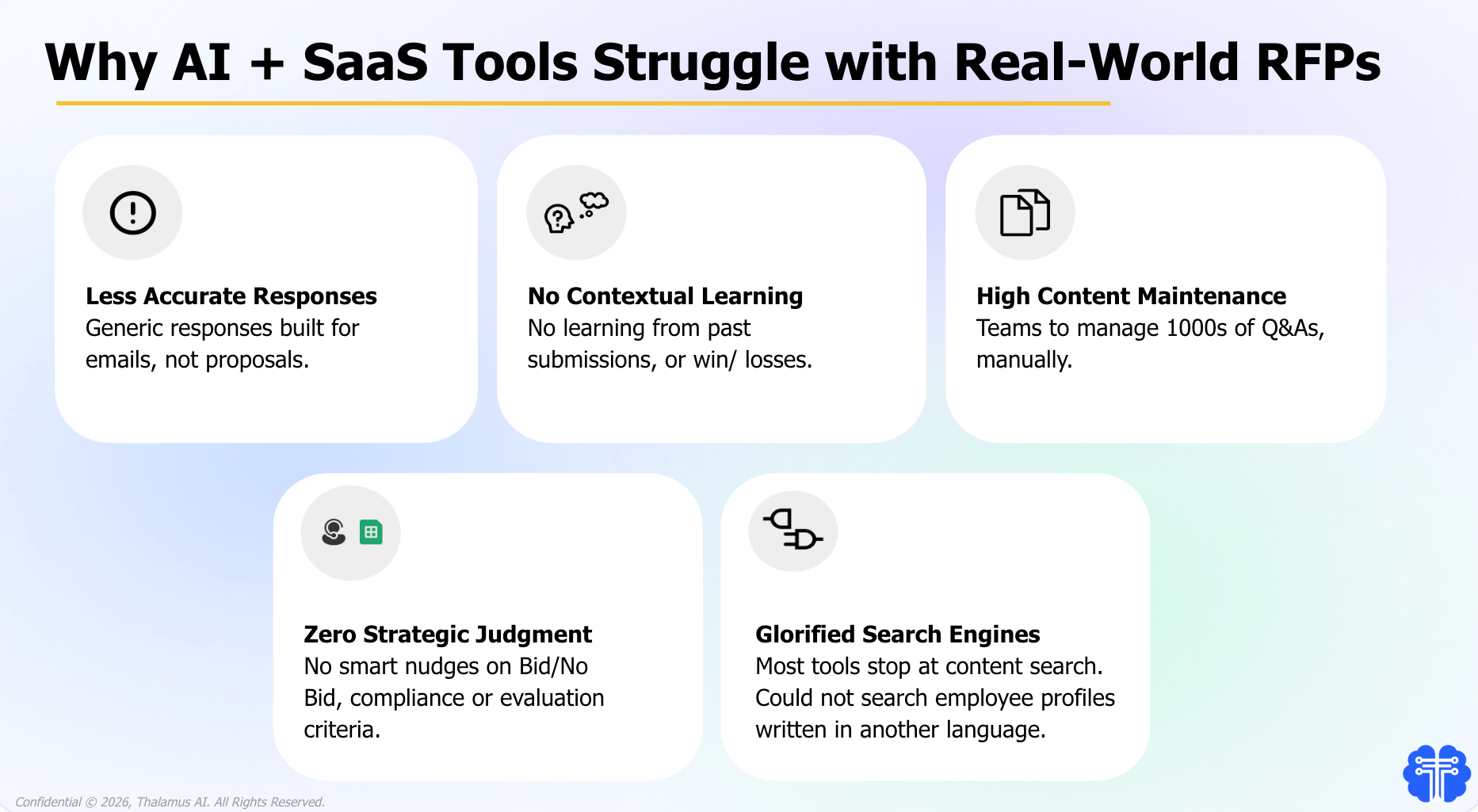
Challenges in Traditional RFP Processes
Responding to an RFP is rarely a solo effort. Proposal teams must collaborate with subject matter experts across product, engineering, security, and legal teams to gather technical inputs, clarify requirements, and validate responses before submission.
In practice, the biggest challenge is often coordinating timely responses from the right people while managing a complex proposal workflow.
Alongside this, teams also deal with 5 to 25 interdependent documents spread across different formats such as PDFs, Excel sheets, and Word files. Even after assembling everything, the final response often turns into a 300-page narrative that is difficult to navigate and even harder to review.
These challenges become even more complex when working with past RFPs. Proposal teams struggle to repurpose previous responses effectively. Content becomes stale, duplicated, or contradictory over time, and RFP libraries require constant manual upkeep to stay usable.
Such long processes and heavy manual work slow proposal teams down and pull them away from what actually matters: creating thoughtful, high-quality proposals and responding strategically to opportunities.
To see how these challenges affect the RFP processes, and how AI can help solve these issues, let’s have a detailed look at the RFP process as a whole, the existing challenges, the possible solutions, and why AI might help proposal teams save hours of time and effort.
1. Managing Multiple Documents and Formats
RFPs rarely arrive as a single document. Proposal teams typically receive a package of files that may include:
1. Technical requirement documents in PDF/ JPEG format
2. Detailed RFP questionnaires in Excel spreadsheets
3. Narrative response templates in Microsoft Word
4. Security questionnaires and compliance forms in separate files
Each document may contain different parts of the buyer’s requirements.
Proposal managers must review these files, extract relevant questions, and organize them into a structured workflow for proposal creation and proposal development.
Without structured workflow automation, teams often switch between multiple documents while tracking responses manually, making the RFP response process difficult to manage and prone to errors.
2. Extracting and Understanding Requirements
RFPs often contain hundreds of questions and detailed requirements spread across multiple documents. Proposal teams must manually go through these documents to identify every question and understand what information is required.
This process typically involves:
- Reading through lengthy documents to locate questions, evaluation criteria, and mandatory requirements
- Extracting questions from multiple formats, such as PDFs, Excel questionnaires, and Word templates
- Interpreting complex or technical requirements to understand exactly what the buyer is asking for
- Mapping questions to the right internal stakeholders, such as product, engineering, security, or legal teams
- Tracking mandatory compliance requirements that must be addressed to avoid disqualification
Because this process is largely manual, it can take significant time and effort. It also increases the risk of overlooking important requirements or misinterpreting what the buyer expects in the response.
3. Dependence on Subject Matter Experts
Most proposal responses require input from multiple internal experts.
Subject matter experts from product, engineering, security, and legal teams must provide specialized information about product capabilities, security certifications, and compliance requirements.
For proposal managers, coordinating these inputs can be challenging.
Because these stakeholders already have their own operational responsibilities, proposal teams often spend significant time following up on questions and waiting for responses.
Without effective team collaboration tools or real-time collaboration workflows, this coordination can significantly delay the proposal development process.
4. Difficulty Reusing Past Content
Most organizations maintain a content library or response repository containing previously written answers, technical documentation, and compliance statements.
These repositories are designed to help proposal teams reuse content from past proposals. However, over time they often become difficult to manage.
Proposal teams frequently encounter:
1. Outdated answers that no longer reflect product updates
2. Multiple versions of the same response stored in different locations
3. Conflicting information across documents
Without proper content optimization and governance, proposal teams may struggle to identify the most accurate Q&A pairs or content sources for a given RFP.
As a result, teams often rewrite responses instead of reusing existing content.
5. Long Review Cycles
Before submission, most proposals must pass through several review and approval stages.
Sales leaders, product teams, security teams, and legal stakeholders may all need to validate different sections of the response.
Each review cycle often requires revisions to proposal drafts, updates to technical explanations, or clarification of security requirements.
Without structured workflow automation, these review cycles can significantly extend the proposal timeline and introduce additional coordination challenges.Before submission, proposals must go through several review stages involving sales leaders, product teams, and legal stakeholders. Each review cycle adds time to the process and can require additional revisions across multiple sections.
6. Limited Time for Strategic Work
Because so much time is spent managing documents, coordinating stakeholders, and searching through past responses, proposal teams often have limited time to focus on strategic aspects of proposal creation.
Instead of refining messaging, strengthening value propositions, or tailoring responses to specific customers, proposal professionals are often consumed by administrative work.
This imbalance is one of the key reasons organizations are now evaluating AI-driven RFP automation and AI RFP software as a way to streamline proposal workflows and improve the overall quality of their proposal responses.
How AI-Driven RFP Automation Helps Proposal Teams Work Faster and Smarter
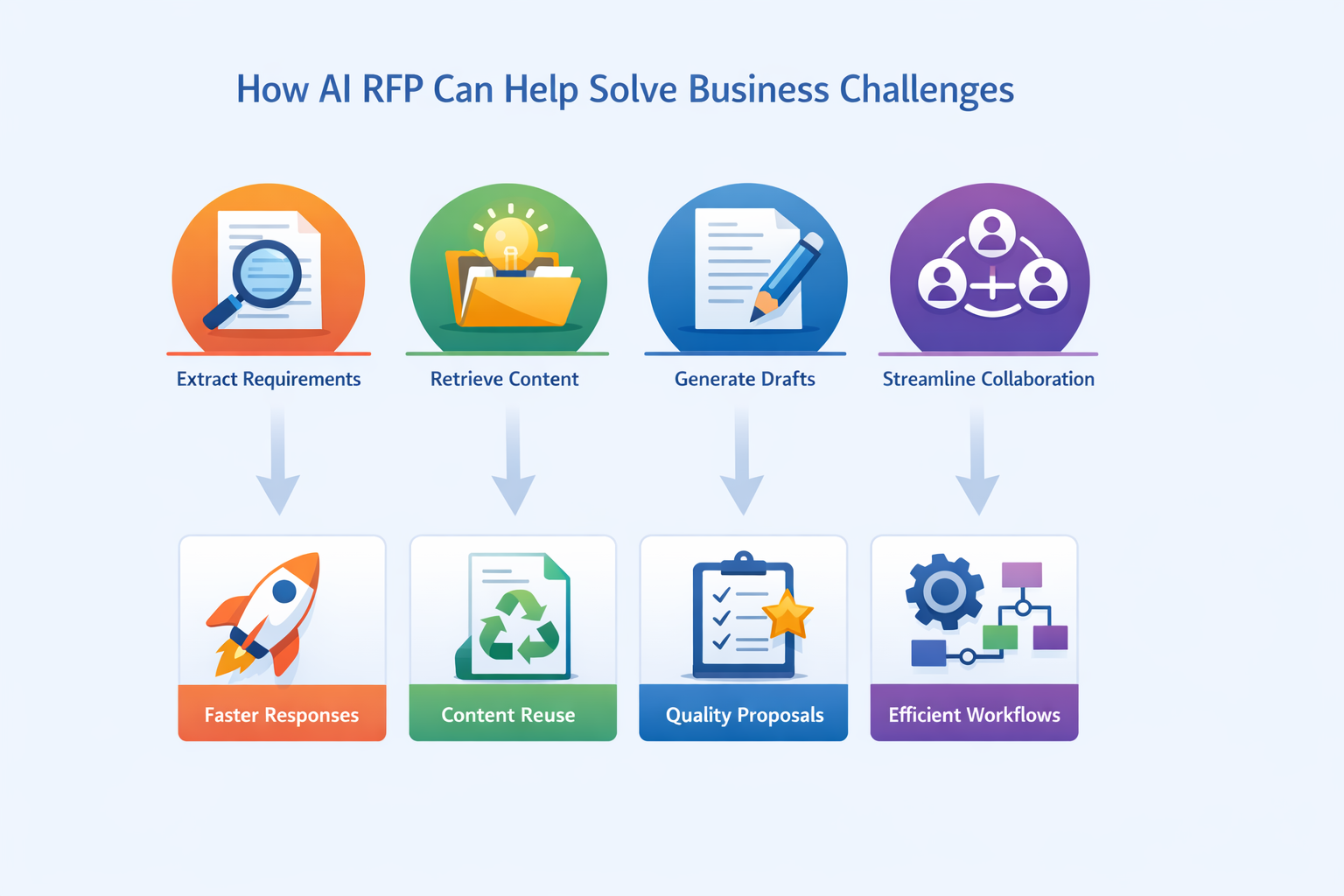
Many of the challenges in traditional RFP response and proposal management workflows stem from the same underlying problem: proposal teams must manually organize large amounts of information across documents, stakeholders, and internal content sources.
Modern AI RFP Software is designed to address these challenges by combining generative AI, machine learning, and workflow automation to support the entire proposal development process.
Instead of manually searching through past proposals, coordinating updates across teams, and assembling responses from scratch, organizations can use AI-driven RFP automation tools to streamline proposal creation, improve collaboration, and accelerate the production of high-quality proposal responses
1. Automatically Extracting Questions from RFP Documents
AI can analyze RFP documents and identify individual questions and requirements, even when they are spread across multiple formats.
This allows proposal teams to:
- Quickly extract questions from PDFs, Word documents, and Excel sheets
- Organize questions into structured sections
- Identify mandatory requirements and evaluation criteria
Instead of manually scanning hundreds of pages, teams can quickly understand what needs to be addressed.
2. Finding Relevant Answers from Past Proposals
Most organizations maintain a content library or content repository containing previously written proposal responses, product documentation, and answers to common security questionnaires.
AI-powered RFP automation tools can search across these content sources to locate the most relevant responses for a given RFP.
This enables proposal teams to:
- Retrieve previously written Q&A pairs quickly
- Identify relevant answers from past proposal responses
- Reduce time spent searching across internal documentation
By improving access to institutional knowledge, AI systems help proposal teams reuse existing content more effectively and maintain consistency across proposal submissions.2. Finding Relevant Answers from Content Libraries
3. Generating Draft Responses
AI-driven RFP automation tools can also assist with content generation during proposal creation.
By analyzing existing proposal responses, product documentation, and technical resources, AI systems can generate initial proposal drafts for common questions.
This allows proposal teams to:
- Quickly generate draft responses for recurring questions
- Maintain consistent messaging across proposals
- Reduce time spent writing repetitive answers
Instead of starting every response from scratch, proposal teams can review and refine AI-generated drafts, improving both response speed and proposal quality.
4. Maintaining and Updating RFP Content Libraries
Over time, proposal teams accumulate large volumes of content in their response libraries and content repositories.
Without proper management, these repositories can become difficult to maintain.
AI-driven proposal management systems can help by:
- Identifying duplicate or outdated responses
- Recommending updates when product or compliance information changes
- Surfacing the most accurate version of a response
This helps organizations maintain a reliable content library, ensuring proposal teams can confidently reuse content in future RFP responses.
5. Improving Collaboration Across Teams
Responding to an RFP often requires coordination between multiple stakeholders across the organization.
AI-powered RFP platforms centralize proposal content and workflows, enabling better team collaboration.
Proposal teams can:
- Assign questions to subject matter experts
- Track progress across proposal sections
- Collaborate using integrated collaboration tools
In many cases, these systems integrate with platforms such as Microsoft Teams, enabling real-time collaboration across distributed teams.
This reduces the back-and-forth communication that typically slows down proposal development.
6. Reducing Time Spent on Repetitive Tasks
AI-driven RFP automation tools also help reduce the time proposal teams spend on repetitive administrative work.
By automating tasks such as document analysis, content retrieval, and draft generation, AI systems enable proposal teams to focus on higher-value activities.
This allows proposal managers to spend more time on:
- Tailoring proposal responses to specific customers
- Strengthening value propositions and competitive positioning
- Improving the overall quality of proposal responses
As a result, organizations can increase the efficiency of their proposal management workflows while improving response quality and win rates.
Benefits/Use cases of AI RFP process for different industries
1. Technology and SaaS Companies
frequently respond to Request for Proposal (RFP) documents, vendor questionnaires, and detailed security questionnaires from enterprise customers.
These responses often require technical explanations about product architecture, integrations, data protection practices, and security certifications.
AI RFP software can help technology teams streamline this process by:
- Retrieving approved answers from a centralized content library or content repository
- Reusing responses from previous proposals and security questionnaires
- Generating consistent proposal responses across multiple sections of an RFP
- Identifying outdated or duplicate responses within the knowledge base
- Maintaining accurate product descriptions and feature documentation
enabling collaboration between proposal teams, product teams, and technical subject matter experts
This enables sales teams and proposal managers to respond to enterprise RFPs faster while maintaining technical accuracy and consistency.
2. AEC (Architecture, Engineering, and Construction)
AEC firms frequently respond to highly structured RFP packages that include multiple documents and strict compliance requirements.
Requirements may be distributed across technical specifications, drawings, project schedules, and compliance forms, making the proposal development process complex and time-consuming.
AI-driven RFP automation helps AEC proposal teams by:
- Building a traceable compliance matrix that maps every requirement in the RFP to the corresponding response
- Identifying relevant project experience and key personnel profiles to include in the proposal
- Supporting responses across multiple document formats such as PDFs, Excel questionnaires, and Word proposal templates
- Maintaining a centralized proposal content library for past project descriptions and technical narratives
- Enabling real-time collaboration with engineers, architects, and project managers
- Supporting bid/no-bid decisions to help firms prioritize the most strategic opportunities
- Generating initial proposal drafts that accelerate the proposal creation process
This allows AEC firms to improve proposal quality while responding to more opportunities without increasing team workload.
2. Financial Services
Banks, financial institutions, and fintech companies frequently respond to RFPs that require detailed information about security practices, data protection policies, and regulatory compliance.
These RFP responses often include extensive security questionnaires and compliance documentation, which must remain consistent across multiple proposals.
AI-powered RFP automation tools can support financial services teams by:
- Organizing responses to regulatory and compliance questions
- Retrieving information from existing compliance documentation and content repositories
- Maintaining consistent responses across multiple proposals
- Ensuring alignment with internal security protocols and governance requirements
This allows proposal teams to maintain accuracy and consistency while responding to complex regulatory RFPs.
3. Healthcare and Life Sciences
Healthcare and life sciences organizations often respond to RFPs that include extensive questionnaires, regulatory documentation, and detailed compliance requirements.
AI RFP software supports these teams by:
- Reducing questionnaire fatigue through structured content generation and response automation
- Providing transparent AI reasoning so teams can trace answers back to their content sources
- Improving response accuracy by learning from historical responses and medical terminology
- Supporting hybrid workflows that combine both traditional proposal responses and structured questionnaires
- Maintaining a centralized content library for regulatory documentation and compliance information
- enabling collaboration between proposal teams and clinical, compliance, and operational subject matter experts
These capabilities help healthcare organizations maintain accuracy while managing complex proposal workflows.
4. Government and Public Sector
Government procurement processes often involve highly structured RFPs with extensive documentation requirements.
Organizations responding to government opportunities must ensure that every requirement is addressed correctly and supported with appropriate documentation.
AI RFP software helps proposal teams manage government RFPs by:
- Identifying mandatory requirements within large procurement documents
- Building a traceable compliance matrix that maps requirements to responses
- Organizing proposal content according to government templates and submission formats
- Retrieving relevant information from past government proposals
- Maintaining consistency across different sections of the proposal
These capabilities help organizations reduce the risk of disqualification while improving the efficiency of the proposal response process.
5. Consulting and Professional Services
Consulting and professional services firms frequently respond to RFPs that require detailed explanations of methodologies, project experience, and team expertise.
AI-driven RFP automation helps consulting teams by:
- Enabling collaboration between consulting teams and subject matter experts during the proposal development process
- Maintaining a centralized proposal content library containing case studies, methodologies, and service descriptions
- Building compliance matrices to ensure all technical requirements are addressed
- Enabling firms to respond to more RFP opportunities without increasing headcount
- Identifying relevant consultant profiles and key personnel to include in proposals
This helps consulting firms scale their proposal operations while maintaining high-quality responses.
How Thalamus AI Helps Organizations Streamline RFP Responses
Across industries, from SaaS and technology to healthcare, construction, and professional services, organizations are realizing that traditional RFP response processes are no longer sustainable.
Thalamus AI is a purpose-built AI RFP platform that combines generative AI, workflow automation, and enterprise knowledge management to help proposal teams respond to RFPs faster and with greater accuracy.
Organizations use Thalamus AI to address several core challenges in the RFP response process. Thalamus AI allows you to:
- Ensure Complete RFP Compliance: Thalamus AI automatically analyzes incoming RFP documents and generates a structured compliance matrix, mapping each requirement to the corresponding response.
- Handle Multi-Document RFP Packages: Thalamus AI can ingest and analyze these multiple document formats simultaneously - including word, PDF, excel, or technical specification documents. The platform automatically extracts requirements, organizes questions, and structures them into workflows
- Centralizing Proposal Knowledge and Past Responses: Thalamus AI provides a centralized knowledge hub that connects to enterprise systems such as SharePoint, Google Drive, and internal document repositories.
- Collaborating with SMEs Without Overloading Them: Instead of relying on long email threads or spreadsheets, Thalamus AI allows proposal managers to assign questions directly to subject matter experts through native integrations with Microsoft Teams and Slack.
By combining AI-driven automation, centralized content management, and structured proposal workflows, platforms like Thalamus AI enable organizations to scale their proposal operations while maintaining accuracy, compliance, and strategic focus.
Looking for a next-gen AI RFP tool for your business? Contact us today.