
How to Calculate and Improve Your RFP Win Rate
RFP win rate is often treated as the north-star metric for proposal teams. And rightly so. It directly reflects how effectively your team converts opportunities into revenue.
But here’s the problem. RFP win rate is only one of the output metrics, not the only metric you should manage.
By the time your proposal win rate drops, the real issues have already happened earlier in the RFP response process. Poor bid qualification. Weak customer understanding. Slow response time. Generic Proposal content and broken team collaboration.
Yet most teams obsess over the final number instead of analyzing what actually drives RFP win rate.
Strong proposal teams take a different approach. They focus on the inputs behind the RFP win rate:
- Bid or no-bid quality
- Response time
- Shortlist ratio
- SME turnaround time
- Compliance accuracy
- Content reuse rate
- Proposal quality
This is where rfp win-leak analysis comes in. Instead of asking “what is our win rate?”, high-performing proposal teams ask:
Where are we losing deals?
Is it a poor bid qualification? Weak customer insights? Slow execution? Generic proposal responses?
Because the truth is simple. Smart teams protect their RFP win rate before proposal creation even begins.
This guide will help you understand not just how to calculate your RFP win rate, but what actually moves it in 2026.
Why RFP Win Rate Matters to Proposal Teams?
RFP win rate is the percentage of proposals your team wins out of the total submitted.
It is one of the clearest indicators of proposal effectiveness and revenue efficiency.
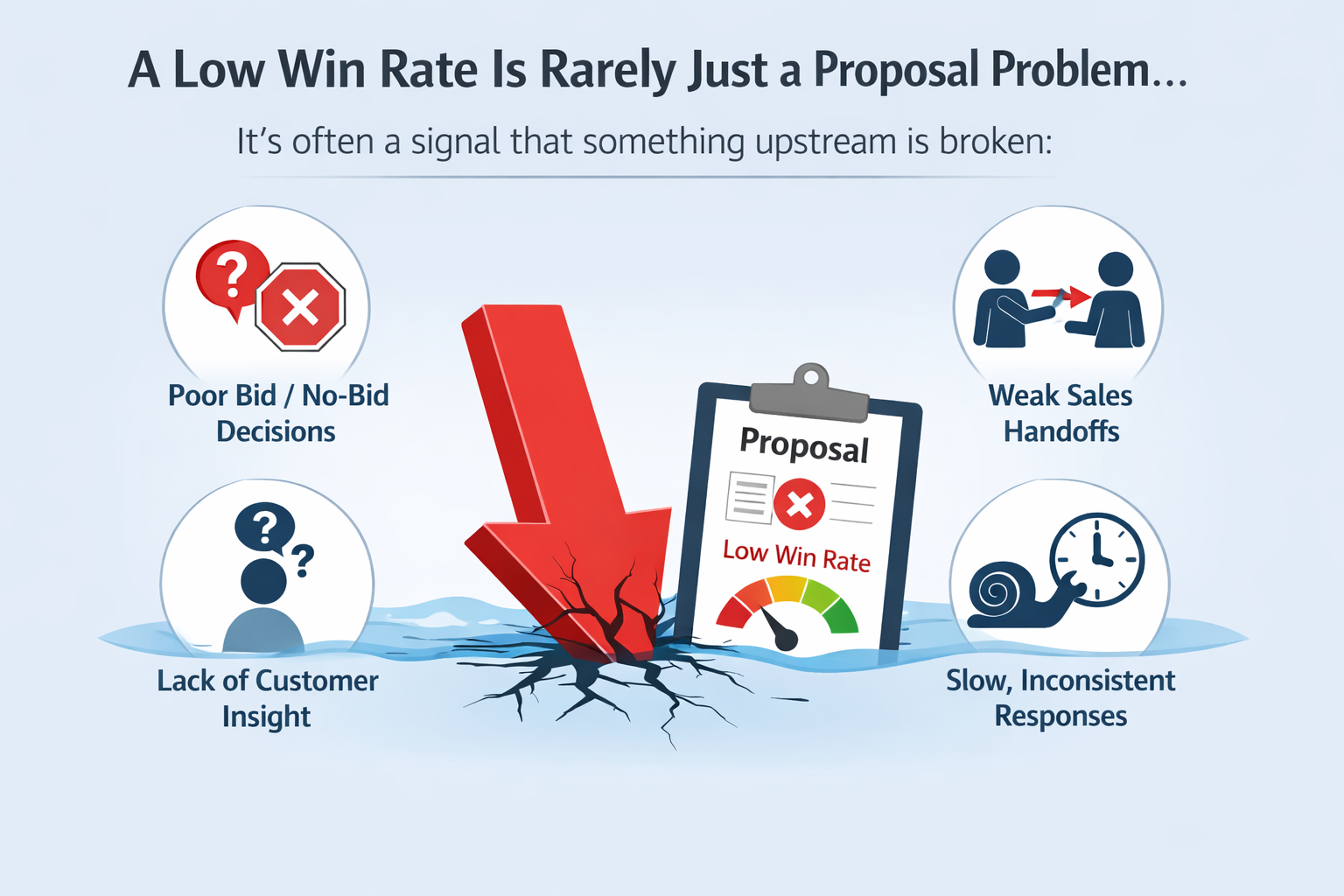
A low proposal win rate is rarely just a proposal problem. It is usually a signal that something upstream is broken:
- Poor bid or no-bid decisions
- Weak sales-to-proposal handoffs
- Lack of customer insight
Slow or inconsistent response time
Many teams track how many RFPs they submit. But high-performing teams track how many they win.
Because more submissions do not equal more revenue. Conversion does.
What is RFP Win Rate? (Definition + Formula)
At its core, the RFP win rate is calculated as:
RFP Win Rate = (Number of RFPs Won ÷ Number of Qualified RFPs Submitted) × 100
The keyword here is qualified.
If you include every incoming RFP regardless of fit, your win rate becomes misleading. Strong teams only measure against opportunities they actively chose to pursue.
For example:
- 20 qualified RFPs submitted
- 6 won
Your RFP win rate = 30%
It’s also important to clearly define outcomes:
- Won
- Lost
- No decision
Modern AI-powered RFP software can automate this tracking. Some tools even calculate win rates in real time and recommend improvements at each stage of the response process.
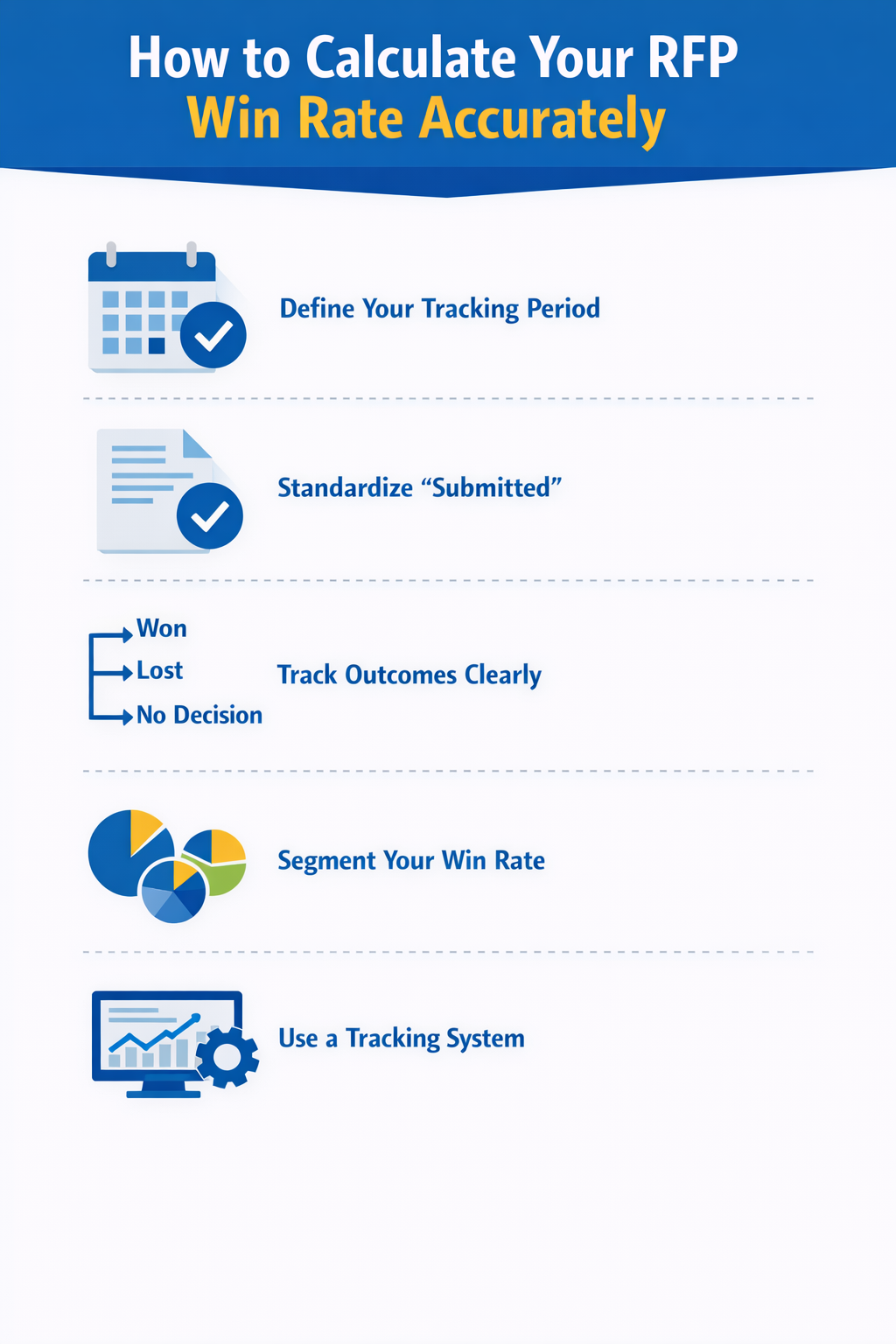
How to Calculate Your RFP Win Rate Accurately
Getting this metric right requires consistency and clarity.
1. Define Your Tracking Period
Choose a consistent timeframe. Monthly, quarterly, or yearly. Without consistency, comparisons become meaningless.
2. Standardize What “Submitted” Means
Clearly define what qualifies as a “submitted” RFP across your team. Only include proposals that are fully completed, reviewed, and compliant with all stated requirements. Drafts, incomplete responses, or bids that were started but never officially submitted should be excluded. This ensures your proposal win rate reflects actual performance, not inflated or misleading data.
3. Track Outcomes Clearly
Every RFP should have a defined status:
- Won
- Lost
- No decision
4. Segment Your Win Rate
This is where insights emerge. Break your win rate down by:
- Deal size
- Industry
- Proposal type
You might discover that you win 50% of small deals but only 15% of enterprise bids.
5. Use a Tracking System
This can be:
- A CRM
- A spreadsheet
- Dedicated RFP software
The tool matters less than consistency.
What is a Good RFP Win Rate?
Benchmarks vary, but generally:
- 20–30% is average
- 40%+ is strong
- 50%+ is elite
But context matters.
A very high win rate could mean your team is only pursuing “safe” opportunities. That might limit growth. On the other hand, a low win rate often signals poor qualification or execution issues.
One of our customers initially tracked its win rate at a high level, comparing RFPs submitted versus won each quarter, without clear visibility into where opportunities were being lost.
When they broke this down into key stages such as bid qualification, compliance gaps, and SME delays, they uncovered “win leaks” across the process. This led to improvements in both shortlist rates and overall win rate.
The real shift wasn’t just measuring win rate. It was understanding what drives it, enabling better bid or no-bid decisions and consistently higher-quality submissions.
The goal is not just to increase the RFP win rate. It is to improve the quality of opportunities you pursue and how effectively you execute them.
Common Mistakes That Hurt Your RFP Win Rate
Most win-rate problems are not random. They are systemic.
Here are the biggest ones:
1. Bidding on Every RFPLack of qualification is the fastest way to dilute your win rate.
2. Poor SME Collaboration: Delays, incomplete inputs, and last-minute scrambling reduce quality.
3. Generic, Copy-Paste Responses: Buyers can tell. And they rarely reward it.
4. Missing Key Requirements: Even strong proposals lose if they fail compliance checks.
5. Weak Sales to Proposal Handoff: Proposal teams lack customer insights, they default to generic responses.
6. No Post-Loss Analysis: Without feedback loops, proposal teams repeat the same mistakes. A post-lost analysis ensures that the mistakes are not repeated.
One of the biggest hidden issues is poor opportunity selection. If you start with the wrong deals, even the best proposals will struggle to win.
How to Improve Your RFP Win Rate
Improving win rate is not about one tactic. It is about strengthening your entire response time ecosystem.
1. Qualify RFPs Before You Bid
Establish clear go or no-go criteria:
- Strategic fit
- Capability match
- Competitive position
- Customer alignment
Not every RFP deserves a response. Discipline here has one of the biggest impacts on win rate.
2. Improve SME Collaboration
This is one of the most common bottlenecks.
Fix it by:
- Assigning clear ownership
- Setting deadlines
- Using structured workflows
Reduce dependency chaos and follow-ups. Thalamus AI enables SME collaboration across the entire RFP response process - starting from bid/ no-bid, where SMEs can contribute early inputs, validate requirements, and shape bid/ no-bid qualification decisions.
During proposal creation, proposal managers can assign SMEs at the proposal, section, or subsection level. That too along with role-based access (reviewer, commenter, editor). This ensures structured collaboration instead of scattered follow-ups.
Every edit is tracked with versioned SME collaboration. This allows lead authors to review, accept, or revert changes - maintaining control, auditability, and consistency across proposal drafts.
3. Build a Strong Content Library
Create a repository of:
- Pre-approved answers
- Case studies
- Proof points
This improves both speed and consistency.
4. Personalize Every Proposal
Winning proposals feel tailored, not recycled.
- Mirror the language of the RFP
- Address specific customer needs
- Highlight relevant experience
Thalamus AI allows proposal teams to add custom instructions to generative AI (for writing) at the section or subsection level, enabling precise control over how content of each part of the proposal is generated.
Proposal managers can embed win themes, customer-specific insights, and sales inputs directly into the response workflow. This ensures every answer aligns with the client’s priorities.
ƒrfpThis enables true proposal customization, where AI generates tailored responses based on context, not reused or recycled content from past RFP responses.
5. Analyze Every Loss
Win rate improves when you learn from losses.
Look for patterns:
- Pricing issues
- Weak positioning
- Competitive gaps
6. Use AI and RFP Software
Modern tools can:
- Extract requirements automatically
- Draft responses faster
- Ensure compliance
- Score opportunities using qualification frameworks
Some platforms even use AI to evaluate bid quality and guide teams toward higher-probability opportunities.
Advanced Tip: Track Leading Indicators (Not Just Win Rate)
RFP win rate is a lagging metric.
To improve it, track what drives it:
- Response time
- SME turnaround time
- Proposal quality scores
- Shortlisting rate
These metrics give you early signals before win rates are impacted. Weak teams measure outcomes. Strong teams measure drivers.
Conclusion: Improve your RFP win rates with a stronger system
Improving your RFP win rate is not about writing better proposals alone.
It is about building a stronger system:
- Better qualification
- Deeper customer insight
- Faster, more structured execution
- Continuous learning from losses
Teams that focus only on the final number often miss the real problem. Teams that focus on the process consistently win more.
Start simple. Track your current win rate. Identify where deals are leaking. Fix those gaps.
Because in the end, the RFP win rate is not just a metric. It is a reflection of how well your entire revenue engine works. If you are looking for an AI-backed software that can help you improve your RFP win rates, talk to us now!